Your Baby Hears Sounds You Can't
Newborns can tell apart the speech sounds of every language on Earth. By their first birthday, they tune in to yours. Here's why that's a win, and why it doesn't mean you missed a window.
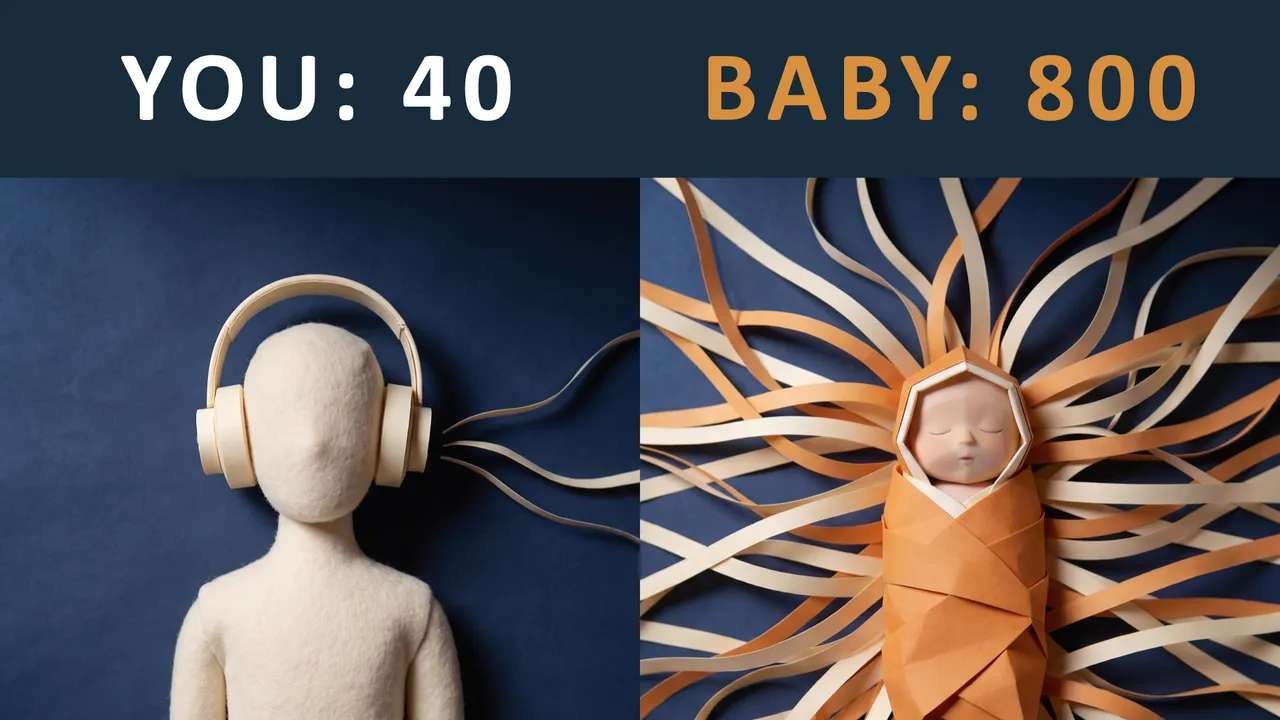
The world’s languages use hundreds of different speech sounds. As an adult, you can reliably tell apart only the few dozen your own language uses. Your brain stopped sorting the rest long ago. A young baby can hear the difference between nearly all of them.
Try it with Mandarin. It has two “ch” sounds where English has one: qī (seven), said with the tongue flat, and chī (eat), said with the tongue curled back. To a billion people they’re as different as “cat” and “bat.” Most English speakers hear the same sound twice. Japanese speakers have the same trouble with English “r” and “l”, and English speakers with Hindi’s two “t” sounds. Every adult is deaf to someone’s alphabet.
How do you test a six-month-old?
Researchers used two clever methods:
- The head-turn game. A sound plays over and over. When it switches to a different sound and the baby turns to look, a toy lights up. Babies learn quickly, so a head turn means they heard the change.
- The pacifier test. Younger babies suck on a pacifier wired to a sensor. They suck faster when something new catches their interest.
Six-month-olds from every language background noticed the Hindi “t”s, the Japanese “r”s, and the rest.
What narrows in the first year
Around 6 months, babies stop noticing differences between vowels their language doesn’t use. Around 10 to 12 months, the same happens with consonants. By the first birthday, a baby tests just like an adult.
This narrowing is about telling sounds apart, not about learning languages. Children keep picking up new languages well for years. And the change can be undone: adults can learn to hear these sounds again with enough practice. It just takes effort.
Your baby is counting
How does a baby know which sounds to keep? It keeps track of how often it hears each one. Sounds it hears all the time stay sharp, and sounds it never hears fade. Your baby has been doing this with your voice since before it could sit up. You are the data.
Why narrow at all? Because speed matters. People talk at about three words a second, often in noisy rooms. Checking each sound against a few dozen options is fast, but checking it against hundreds would be far too slow. Your baby gives up hearing everything to get fast at hearing you.
The study every “baby language” product should mention
In one study, 9-month-old American babies got 12 short Mandarin sessions. Some had a live tutor, some watched the same tutor on video, and some heard audio only. Only the babies with the live tutor kept their ability to hear the Mandarin sounds. The video and audio groups did no better than babies who heard no Mandarin at all. In the first year, babies learn speech sounds from a person paying attention to them, not from a recording.
What you can do with this
- Talk to your baby, and keep the sing-song voice. Slow, high-pitched, exaggerated “parentese,” especially one-on-one, is linked to bigger vocabularies later.
- Use both languages if you have two. Bilingual babies keep the sounds of both languages. The old worry that two languages confuse babies isn’t supported by the evidence.
- Don’t count on screens for language in the first year. For learning speech sounds, a recording didn’t work. The person holding the flashcards matters, not the flashcards.
- Don’t panic if your child is past one. Exactly when accent and grammar windows close is still debated, and recent research suggests grammar learning stays open much longer than people used to think.
You didn’t miss a window. You were the window.
Sources
- Werker & Tees, “Cross-language speech perception: evidence for perceptual reorganization during the first year of life” (1984), Infant Behavior and Development
- Kuhl et al., “Linguistic experience alters phonetic perception in infants by 6 months of age” (1992), Science
- Maye, Werker & Gerken, “Infant sensitivity to distributional information can affect phonetic discrimination” (2002), Cognition
- Kuhl, Tsao & Liu, “Foreign-language experience in infancy: effects of short-term exposure and social interaction on phonetic learning” (2003), PNAS
- Bradlow et al., “Training Japanese listeners to identify English /r/ and /l/” (1997), Journal of the Acoustical Society of America
- Ramírez-Esparza, García-Sierra & Kuhl, “Look who’s talking: speech style and social context in language input to infants are linked to concurrent and future speech development” (2014), Developmental Science
- Hartshorne, Tenenbaum & Pinker, “A critical period for second language acquisition: evidence from 2/3 million English speakers” (2018), Cognition
This is educational content, not medical advice. For anything about your own baby, talk to your pediatrician.