Why Are Chinese Babies Out of Diapers So Early?
Many toddlers in China are dry in the daytime by about 20 months; in the US the average is closer to 37. It isn't genetics. It's three everyday habits, and the evidence for each is different.
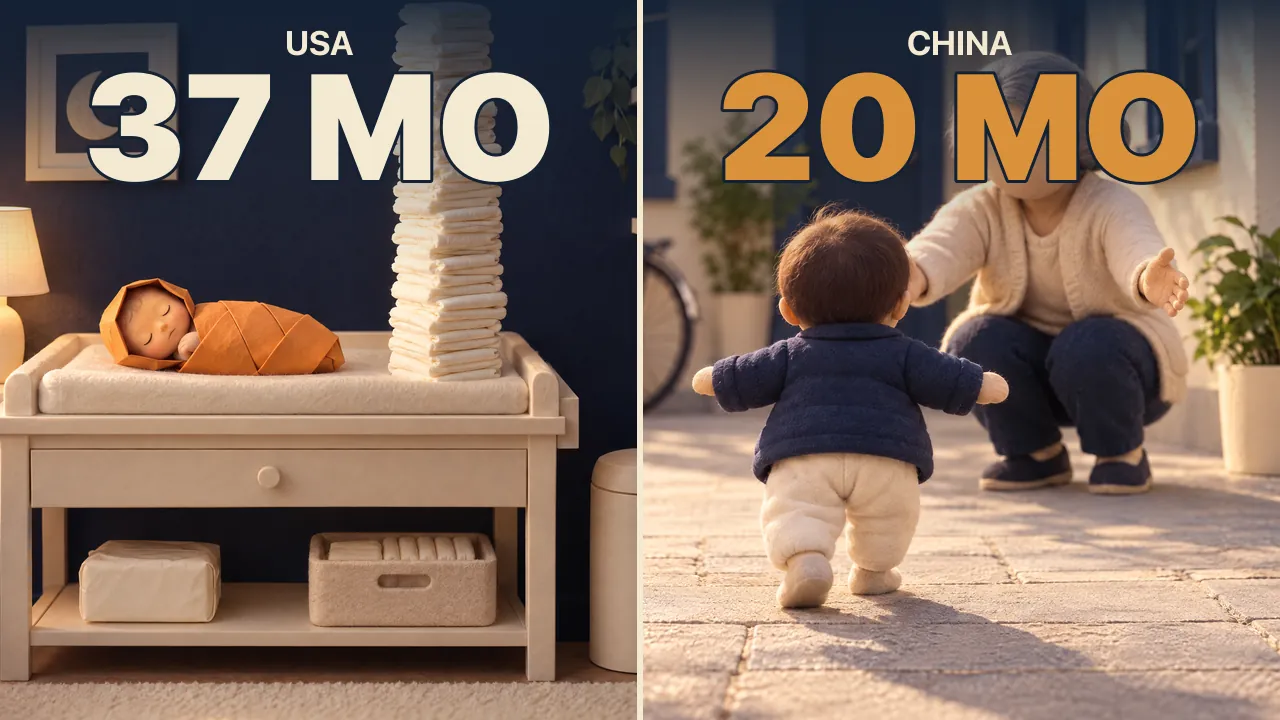
In a courtyard in China, a grandmother holds a three-month-old out over a drain. No diaper. She leans in and whispers xū xū, and more often than you’d think, the baby goes. To American eyes, that’s a party trick. To her, it’s Tuesday.
In the US, the usual plan is diapers until about three: six or so a day, somewhere around seven thousand in all. In China, many toddlers are dry in the daytime by about 20 months. In the US, the average is closer to 37. That’s not genetics. Every baby gets the same bladder. It’s habits, and American grandmothers used to have them too.
What “out of diapers” actually means
Think of your baby’s bladder as a little balloon with a doorbell on top. When it fills, nerves ring the bell. In a newborn, the door simply opens by itself. It’s a reflex, and nobody’s home to answer.
Potty training is the brain learning three jobs: hear the bell, hold the door, open it on cue. Every baby learns them. The question is when.
The fine print: the 20 months comes from one Chinese study and the 37 from one American study, and they measured slightly differently. But a similar gap shows up between Vietnam and Sweden, so the gap looks real. What causes it is where the habits come in.
Habit #3: split pants (kāi dāng kù)
Split pants are toddler trousers with an open seam underneath and no diaper, outdoors too. The idea is simple: when a toddler in split pants wets, they feel it right away, every time. The bell rings loud.
A modern diaper holds a lot and pulls the wet away from the skin, so the baby barely notices. A US review of potty training says disposable diapers likely helped push training later. But nobody has tested split pants on their own, and the trade-offs are real: puddles, cold winters and, well, outdoors. Many young Chinese parents skip them for exactly that reason. Some families take a middle path with training pants that let the wet be felt, or use split pants by day and a diaper at night.
Habit #2: the sound (bǎ niào, “holding out”)
When the baby squirms, goes still, or it’s simply been a while, Grandma holds them out over a potty, a drain or a very patient tree, and makes a soft sound: xū xū. It’s the same sound every time, and after a while the sound alone can start the flow. Western parents who try it call it elimination communication. In China it’s mostly just called Grandma.
Does it change the bladder, or just the laundry? Researchers checked with ultrasound: wait until the baby pees, then look at what’s left inside. In a 2013 Swedish–Vietnamese study, a team followed 47 babies in Vietnam from birth to age three. Their mothers held them out and whistled. By 9 months the babies were emptying their bladders fully, something Swedish children in diapers reached at around three in earlier studies, and 98% were potty trained by age 2.
That’s 47 babies, two countries and different everything, and nobody chose at random which babies got whistled at. Promising, not proven. And the headline it turned into, “babies potty trained at nine months”, isn’t what the study said.
It’s the cheapest habit to try: one soft sound at changing time. Or none.
Habit #1: not waiting for “ready”
This is the one American parents find hardest. The American advice is readiness: wait until your child sends the signals, like staying dry for a couple of hours, asking, or hiding behind the sofa to poop. Then you start, usually somewhere after two, and until then the diaper catches everything.
In many Chinese homes, the adult reads the signals instead, from the first weeks or months: a squirm, a grunt, the time since the last feed. That means someone watching the baby all day, and still missing a lot. It’s why it’s so often Grandma’s job. It’s close to a full-time one.
Is earlier better? It depends on what “early” means. In a US study of about 400 children, the ones who started intensive training very young didn’t finish sooner. They just spent longer at it. Drills at two aren’t the same as a soft sound from week one, and the readiness advice was partly a rescue from older schedules that could be harsh. Serious pediatricians disagree on readiness versus early holding out, and nobody has run the long head-to-head study. What everyone agrees on: pressure and punishment backfire.
The twist: America used to be China
In the 1940s, American parents commonly started potty training before 18 months. Then disposable diapers went mainstream in the 1960s, got super-absorbent gel, and came in sizes for four-year-olds. The bladder didn’t change in seventy years. The house did.
Now China is running the same experiment on itself. In the cities, young parents buy diapers and split pants look old-fashioned. Chinese researchers have noticed bedwetting in school-age children rising from about 4% in 2006 to about 7% by 2017. One team compared hundreds of children who wet the bed with hundreds who didn’t: the bedwetters had stopped daytime diapers at about 26 months, the dry kids at about 20, and most of the dry kids’ families had done the xū xū.
That’s a link, not proof. Children who develop a little later might stay in diapers longer and wet the bed longer for the same reason. And bedwetting is common. It’s nobody’s fault.
Meanwhile, a small number of American parents now do the Grandma method, with books and a new name. The two houses are swapping habits.
Three habits, three verdicts
- Split pants: untested on their own, and a big trade in laundry.
- The sound: promising, not proven, and almost free.
- Not waiting for ready: genuinely debated. If you try it, keep it gentle and never pressured.
The one thing that is settled: the age a child leaves diapers moves with what the house does. So 37 months isn’t late. It’s the average in the diaper house. The chart is measuring houses, not children.
Which house you run is your call. Both get to the same ending: a dry kid who never thinks about any of this again. Diapers end. Every single one.
About bedwetting
Bedwetting is common and it’s nobody’s fault. If it’s still happening after about age five or six, or it starts again after a dry spell, mention it to your child’s doctor.
Sources
- Li, Wen, Shen et al. (2020), Scientific Reports: disposable diaper overuse and bedwetting in Chinese children
- Blum, Taubman & Nemeth (2003), Pediatrics: starting toilet training early and when children finish
- Duong, Jansson, Holmdahl, Sillén & Hellström (2013), Journal of Pediatric Urology: 47 Vietnamese babies followed from birth to age 3
- American Family Physician, “Toilet Training” (2008): earlier training in the 1940s and the effect of disposable diapers
- Wen et al. (2006), European Urology: bedwetting in school-age children in China
- Brazelton (1962), Pediatrics: the child-oriented “readiness” approach
- Gottlieb, “Diapers, potties and split pants” (2017), The Conversation: split pants and how they’re changing in Chinese cities
This is educational content, not medical advice. For anything about your child, talk to your doctor.