What Happens to Dad When the Baby Arrives?
He isn't pregnant and doesn't make milk, but a new dad's hormones and brain still change. What decides how much isn't being a man. It's the hours of hands-on care.
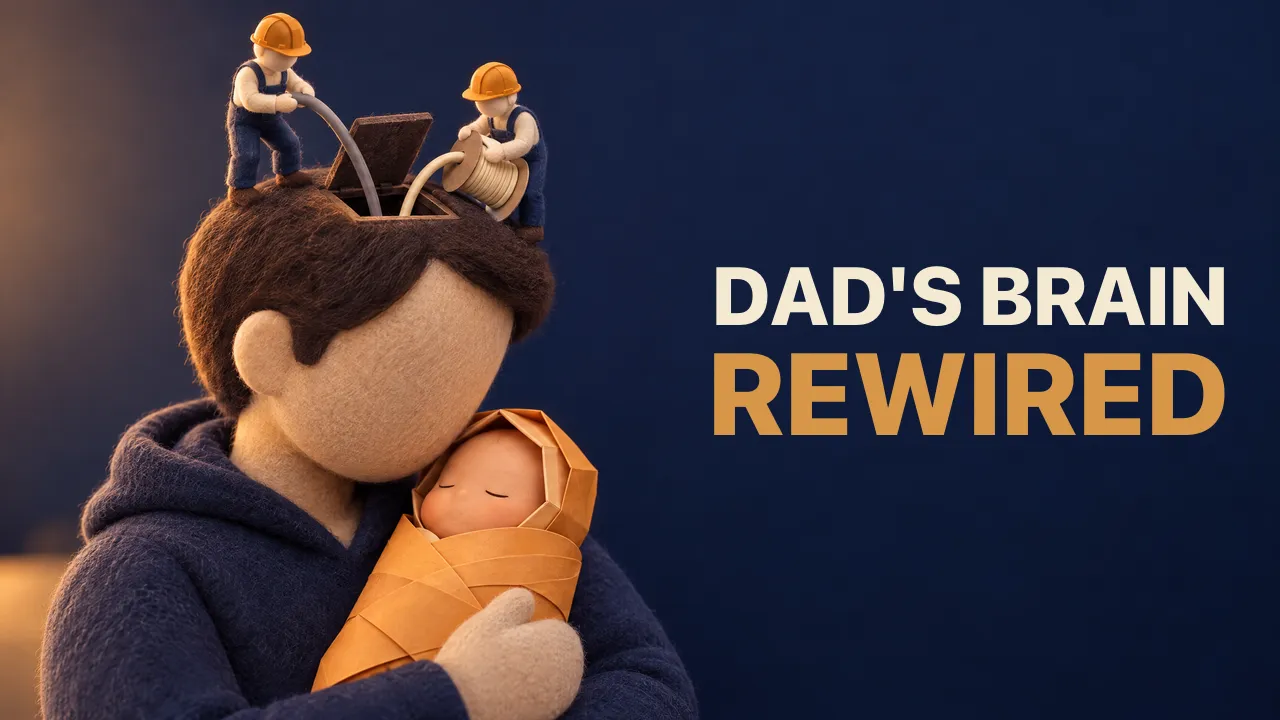
When a baby arrives, everyone asks how Mom is doing. Fair enough: she grew a person. Dad wasn’t pregnant and doesn’t make milk, so surely his body just carried on as before. Except now he sways whenever he’s holding anything: a laptop, a bag of flour, a burrito. When researchers measured new fathers, they found real changes in their hormones and brains. And what decides how much he changes isn’t being a man. It’s something you can count.
His hormones shift
- Testosterone drops. In the Philippines, researchers followed hundreds of young men from about age 21 and measured them again four and a half years later. The men who had become fathers saw their evening testosterone fall by about a third, much more than men without kids. Dads doing 3+ hours of childcare a day had the lowest levels. The men who started highest were actually the likeliest to become dads, so becoming a father lowers it, not the other way around.
- It can start before the birth. In a Michigan study of 29 couples, fathers’ testosterone fell during the pregnancy, and the bigger the drop, the more baby care they did later.
- Sympathy pregnancy symptoms are real for some dads. Dads with nausea and cravings had higher levels of prolactin, the hormone linked to milk production.
- The dad bod has a study. Among 10,000 American men followed into their 30s, those who became live-in dads gained about four pounds, while men without kids lost a little.
- Oxytocin, the “cuddle hormone,” rises in dads too. An Israeli team found similar levels in new mothers and fathers. In moms it went with cuddling and baby talk, and in dads with play, lifting and tickling. That’s the same chemical used in a different style, though every family varies.
Claims that rough play “builds bravery” or that dads’ words build vocabulary rest on real but small studies. Researchers still debate what’s special to dads and what simply comes from whoever does the playing.
A “dad brain” is really a carer’s brain
An Israeli team filmed 89 first-time parents playing with their babies at home, then showed them the videos inside a brain scanner. There were three groups: mothers who did most of the care, fathers who helped, and two-dad families where one father did the main caregiving.
Two brain systems lit up. One is the alarm, the fast, emotional part that reacts when your baby might need you. The other is the reader, the part that works out what someone else wants. Mothers had a hot alarm, and helper dads leaned on the reader. Dads who were the main carer had both, with an alarm as active as the mothers’. In every father, the more hours of hands-on care he did, the more closely the two systems worked together.
It isn’t a mother’s brain. It’s a carer’s brain, and whoever does the hours builds one.
Teams in Spain and the US also scanned first-time fathers before and after the birth. Parts of the brain’s outer layer got slightly smaller. That’s not damage: mothers’ brains do this even more, likely trimming what isn’t needed. The dads who changed most felt the most bonded and spent the most time with their baby. These studies are small, so treat this as promising, not proven.
Dads get postpartum depression too
About 1 in 10 new fathers experience depression, most often 3 to 6 months after the birth, and more often when their partner is depressed too. In men it may not look like sadness. It can show up as irritability, anger, working long hours or going quiet. It’s common and it’s treatable.
What this means for your family
- Hand him the baby and leave the room. The brain learns by doing, not by watching.
- Different isn’t wrong. His sway is different and his swaddle is worse, and the baby is fine. It’s a second way of being looked after.
- Ask Dad how he’s doing, and really ask. If he’s been angry, flat or quiet for weeks, that’s worth seeing a doctor, just as it would be for you.
- Skip the testosterone tests and supplements. Nobody knows whether a bigger drop makes a better dad. Sleep loss lowers testosterone too. What is settled is that dads change in country after country, and the hours drive it.
He wasn’t born a dad. He’s being built, one night shift at a time.
If Dad (or you) is struggling
Postpartum depression and anxiety happen to fathers too, and they’re treatable. Postpartum Support International has help for dads (US HelpLine: call or text 1-800-944-4773). If anyone is in crisis, call or text 988 in the US, call 116 123 (Samaritans) in the UK and Ireland, or your local emergency number.
Sources
- Gettler et al. (2011), PNAS: the Cebu study of testosterone in new fathers
- Edelstein et al. (2015), American Journal of Human Biology: fathers’ testosterone during pregnancy
- Edelstein et al. (2017), Developmental Psychobiology: prenatal drops and later infant care
- Storey et al. (2000), Evolution and Human Behavior: prolactin and sympathy pregnancy symptoms
- Garfield et al. (2016), American Journal of Men’s Health: the dad bod
- Gordon et al. (2010), Biological Psychiatry: oxytocin in mothers and fathers
- Paquette (2004), Human Development: rough play and the “activation relationship”
- Pancsofar & Vernon-Feagans (2006), Journal of Applied Developmental Psychology: dads’ words and vocabulary
- Abraham et al., “Father’s brain is sensitive to childcare experiences” (2014), PNAS
- Martínez-García et al. (2023), Cerebral Cortex: brain changes in first-time fathers
- Saxbe et al. (2024), Cerebral Cortex: brain changes, bonding and time with the baby
- Hoekzema et al. (2017), Nature Neuroscience: mothers’ brain changes
- Paulson & Bazemore (2010), JAMA: depression in new fathers
- Muller et al. (2009), Proceedings of the Royal Society B: the same pattern in Tanzania
This is educational content, not medical advice. For anything about your family, talk to your doctor.